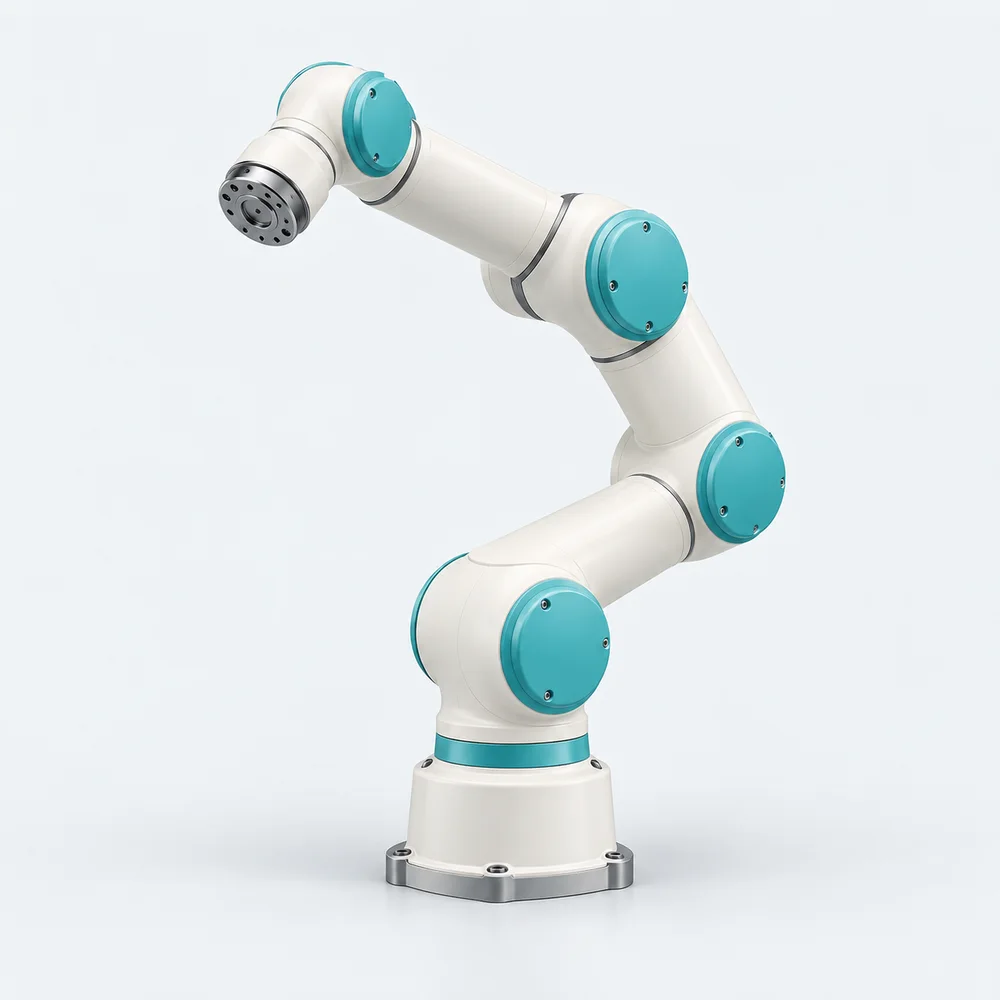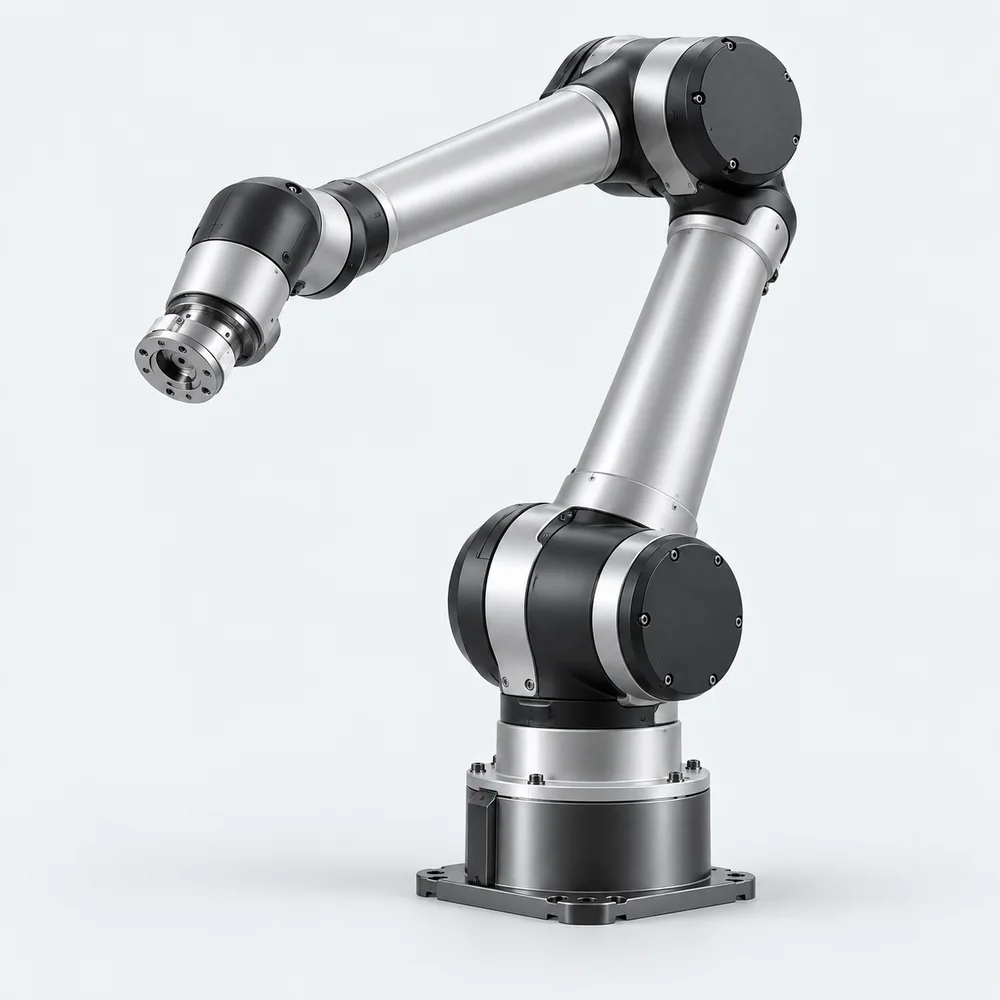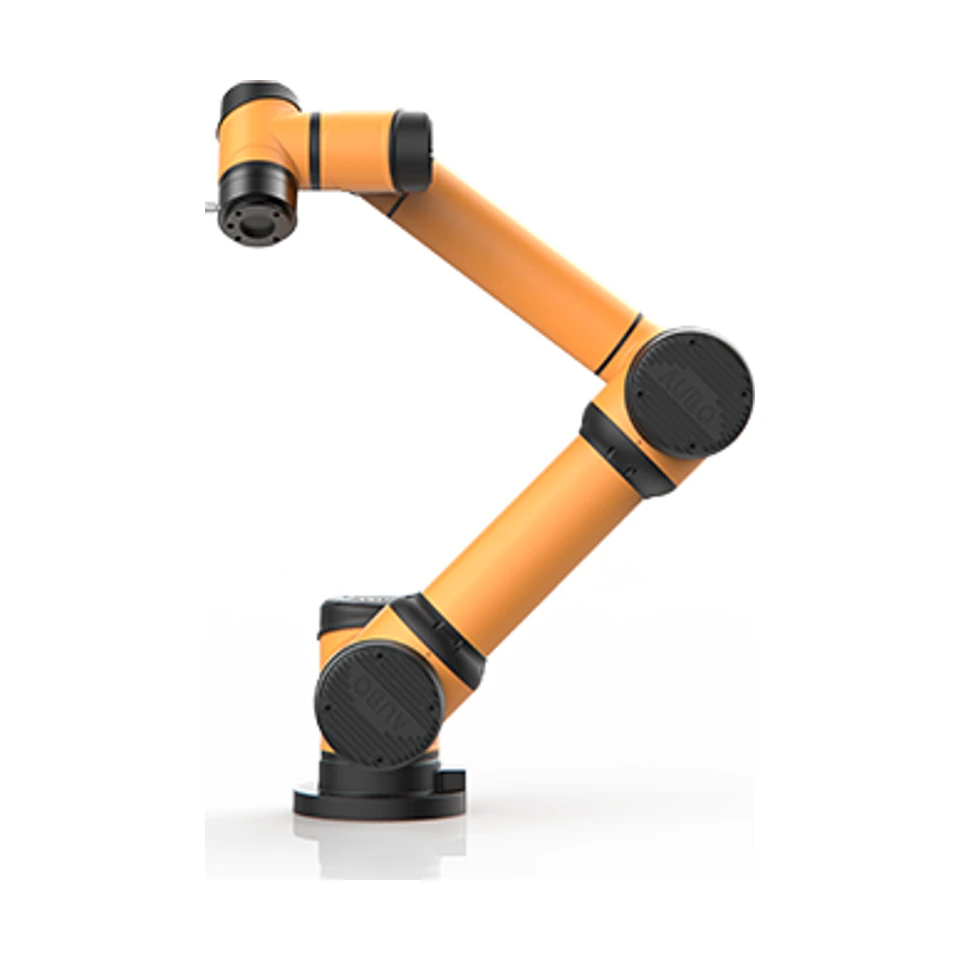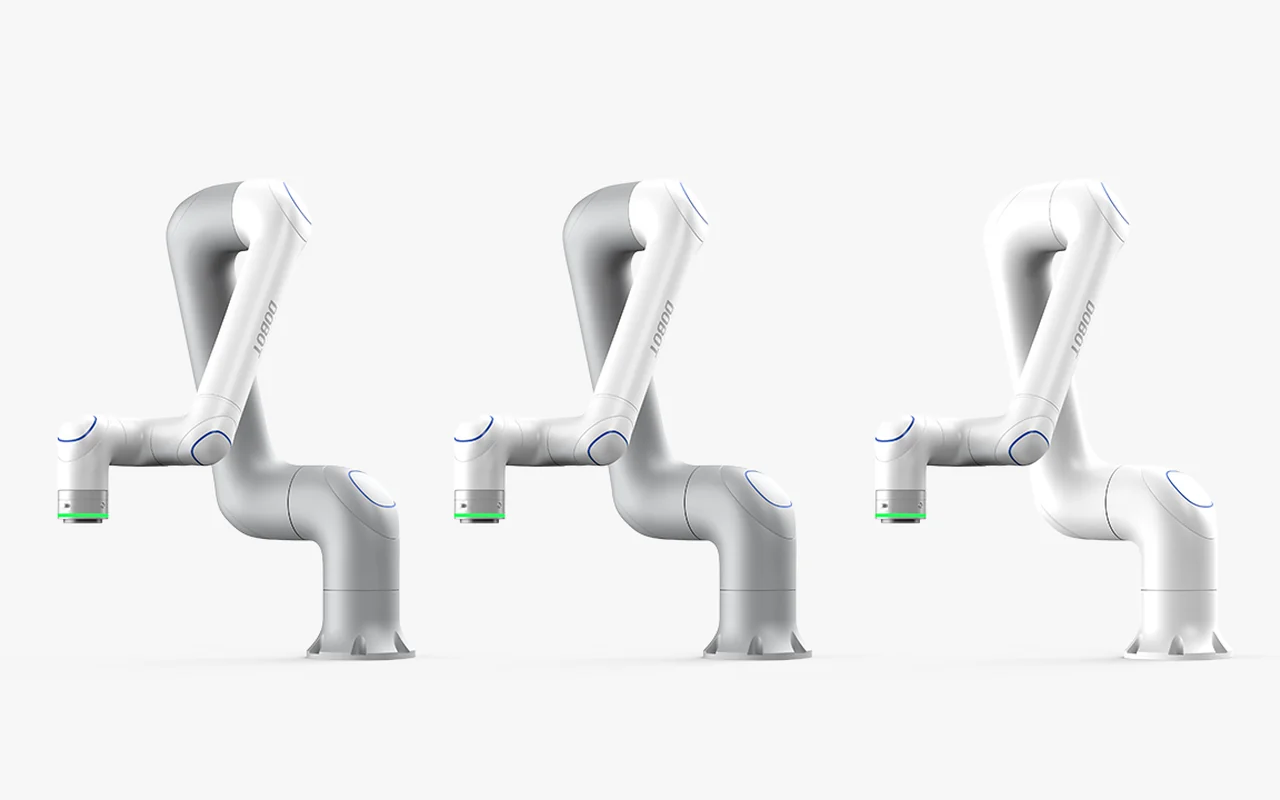
“Cobot” is short for “collaborative robot”: a manipulator that can be placed next to people without a full fence, if the risk assessment of the specific cell allows it. That caveat matters most: it is not the arm alone that is safe, but the whole workstation together with the tool, the part and the way people work next to it.
Below we look at how a cobot is built differently, what the standards say, where it genuinely beats a classic industrial robot and where it loses.
How a cobot is built
Unlike a classic industrial robot, which is designed for high speed and heavy loads and works behind a fence, a cobot is designed so that a collision with a person is as harmless as possible. This is achieved with torque or current sensors in the joints, limits on force and speed, and a light design without sharp edges.
The second difference is programming. Most cobots in the SHKARAN catalog support hand-guided or drag-and-drop teaching, some models can be programmed from a tablet or phone (JAKA Zu 7), and some offer open interfaces for Python and ROS (AUBO i5, UFACTORY Lite 6, Elephant myCobot). This lets you launch a task without a dedicated robotics specialist.
What the standards say
The safety of industrial robots is described by ISO 10218-1 (the robot itself) and ISO 10218-2 (integration and the cell). Human–robot collaboration is further covered by the technical specification ISO/TS 15066. It describes four collaboration modes:
- monitored safety stop: the robot stops when a person enters the zone and resumes after they leave;
- hand guiding: the operator moves the robot’s arm by hand, for example to teach a path;
- speed and separation monitoring: the closer the person, the slower the robot, down to a stop;
- power and force limiting: contact is allowed, but force and pressure must not exceed the limits permitted for body parts.
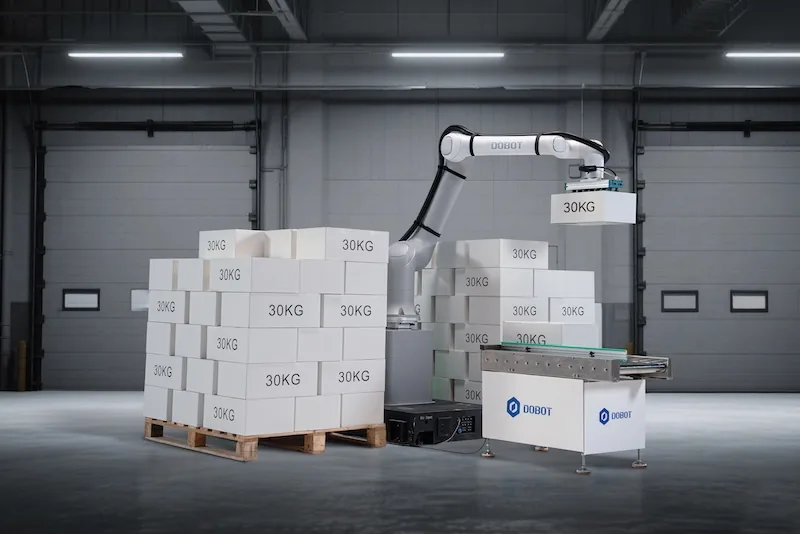
The practical conclusion: even the “softest” cobot becomes dangerous if it carries a sharp tool, a hot part, a welding torch or a heavy load. That is why the risk assessment is done for the whole application, not for the arm alone, and in some tasks a fence is still required.
Cobot vs. classic robot: comparison
| Parameter | Cobot | Classic industrial robot |
|---|---|---|
| Works alongside people | Possible if the cell’s risk assessment is positive | Usually behind a fence or in a zone with sensors |
| Load | In the SHKARAN catalog — from 250 g to 15 kg | Can reach hundreds of kilograms |
| Cycle speed | Limited for safety | Higher, limited mainly by mechanics |
| Programming | Hand guiding, tablet, graphical environments, Python/ROS | Controller languages, offline programming, a specialist is required |
| Changeover to another product | Fast, suited to small batches | Slower, pays off on large batches |
| Typical tasks | Machine tending, packing, assembly, laboratories, cafés | Welding, casting, heavy palletizing, high-speed lines |
Where a cobot wins
- many different products and small batches, where the robot has to be reconfigured often;
- limited floor space where a fence simply won’t fit;
- first automation: you need a quick start without heavy integration;
- stations where a person and a robot share the work: the person feeds or inspects, the cobot does the repetitive action.
Where a classic robot is better
- heavy parts and tools that exceed a cobot’s payload;
- high cycle speeds that a cobot cannot deliver because of safety limits;
- high-volume production where a robot repeats one action for months inside a fence;
- hazardous operations — welding, handling hot and sharp parts — where a fence is required by the nature of the task.
SHKARAN editorial conclusion: if the task is to load a machine, pack, assemble or move a light part next to people, start with a cobot. If speed and mass matter, consider a classic robot. And to avoid mistakes with a specific model, focus on payload, reach and repeatability — we cover these parameters in a separate article.
Read also
- How to choose a cobot: payload, reach, accuracy and safety
- Cobot at the machine: automating part loading
Frequently asked questions
Is a cobot a safe robot?
Not by itself. A cobot’s design reduces the risk of contact, but safety is determined by the whole cell: the tool, the part, the speed and how people work nearby. That is why a risk assessment is done under ISO 10218 and ISO/TS 15066.
Does a cobot need a fence?
Not always. If the risk assessment shows that a fence is not required, the cobot works without one. With sharp tools, hot parts and hazardous operations a fence usually remains.
How is a cobot different from an ordinary industrial robot?
Lower payload and speed, force sensors in the joints, hand-guided teaching, quick changeover. A classic robot is faster and stronger but usually works behind a fence.
Which cobots can I order through SHKARAN?
The catalog includes Dobot, AUBO, JAKA, UFACTORY, Elephant Robotics, AgileX, as well as Western brands to order. Models and specifications are in the “Cobots and manipulators” section.