Loading a machine seems simple: pick up a blank, place it, wait for processing, and remove the finished part. That’s why machine tending is often seen as the first cobot project. But between a hand movement demo and stable cell operation lies a whole system: tooling, signals, part prep, and maintenance.
Below is a practical sequence for task selection and pilot preparation. It’s suitable for initial discussions between production and integrator, helping define requirements before choosing a manipulator brand. The real example is from Universal Robots’ Go Fast Campers case; other scenarios and calculation points are editorial recommendations.
Start by observing a single operation
During several normal cycles, record everything the operator does. Don’t just watch the loading: the employee may clean the seat, adjust the blank, check the surface, measure the part, and swap containers. If these steps are missed in the description, the robot will only repeat the visible part, leaving the rest for the human.
Record machine processing time separately from service time. For long processes, the main gain may be from reducing wait time between cycles. For short operations, it’s more important to check if the robot completes all transitions in time. There’s no universal answer based on a single rated arm speed.
What a robotic cell consists of
The manipulator is central, but not the only component. You need a way to supply blanks, a gripping tool, positioning, signal exchange with the machine, and a place for finished parts. The door, clamp, and auxiliary mechanisms must also be part of the coordinated sequence. Separately, define who and how services the setup between batches.
| Node | What to clarify before ordering |
|---|---|
| Blanks | Where the robot picks them from and how position is determined |
| Gripper | How holding is confirmed and tooling weight is considered |
| Machine | What signals are available and who handles the interface |
| Positioning | How correct placement in the fixture is achieved |
| Finished parts | Where they accumulate and how overflow is prevented |
| Rehabilitation | What the operator does after a routine stop |
Real-world example: Go Fast Campers
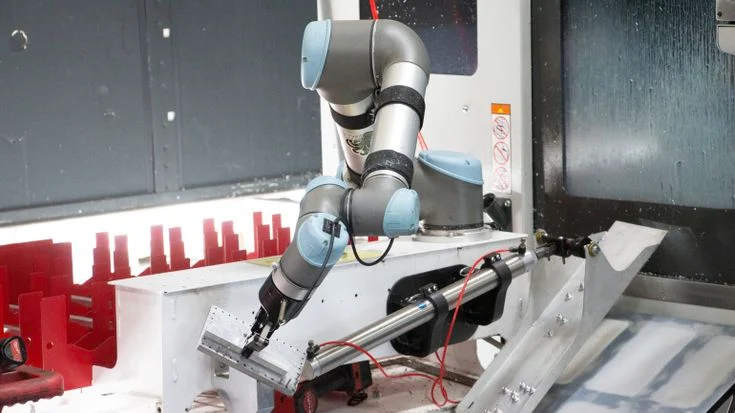
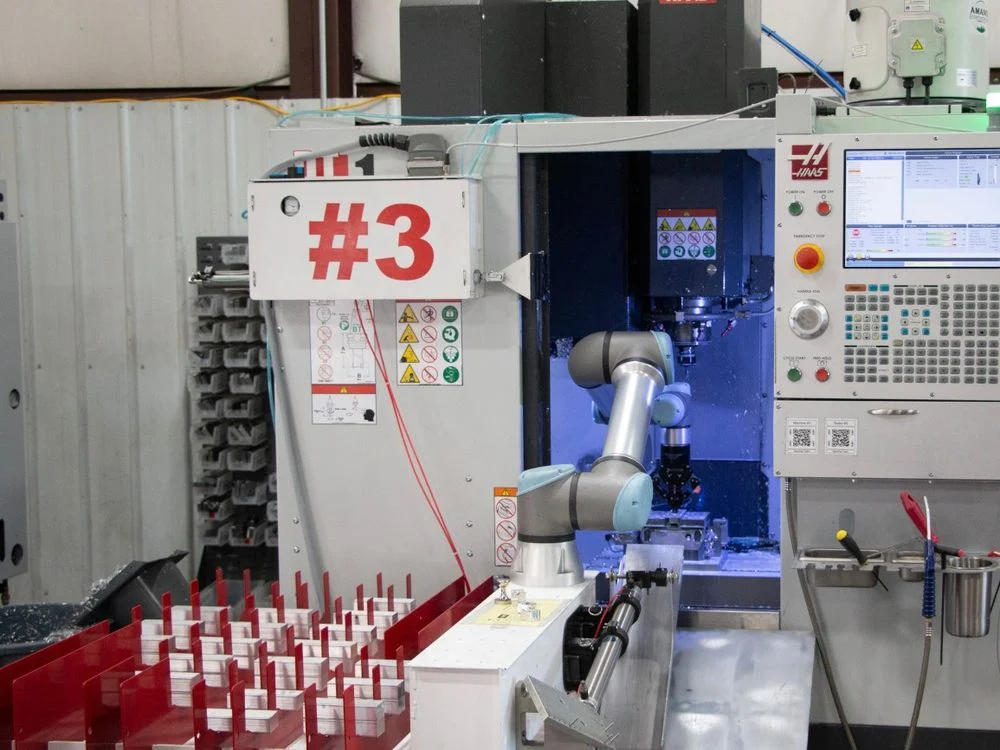
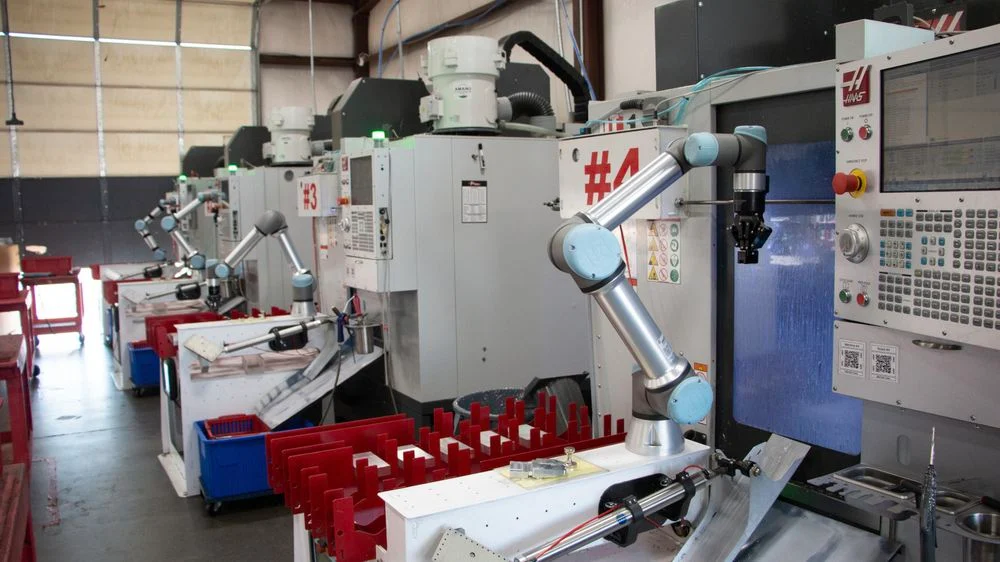
In the Universal Robots case study, camper manufacturer Go Fast Campers uses four cells with cobots and Haas machines. The company describes working with aluminum blanks, intermediate positioning, loading, and flipping the part for the next operation. This demonstrates that the result is achieved through a sequence of operations, not just a single transfer.
The same case study reports about 22 hours of machine time per day, including six hours of unattended operation. These are the figures for a specific facility and cannot be generalized as a commercial promise for other manufacturers. In practice, it is more useful to study the process setup: standardization of blanks, management of auxiliary mechanisms, and reuse of programs.
How to choose the first part for automation
For a pilot, it is convenient to select an operation with clear geometry, stable feeding, and a sufficient number of repetitions. However, you should not specifically choose an ideal blank that is rarely encountered in actual production. The test batch should include typical deviations: dimensional differences within tolerance, surface condition, and common effects from the previous stage.
If the product range changes frequently, group similar parts into families. It is possible that one set of tooling can handle several sizes, while others may require finger changes or a separate fixture. It is better to assess these transitions in advance: lengthy retooling can negate the gains on a short production run.
Gripping, referencing, and chips
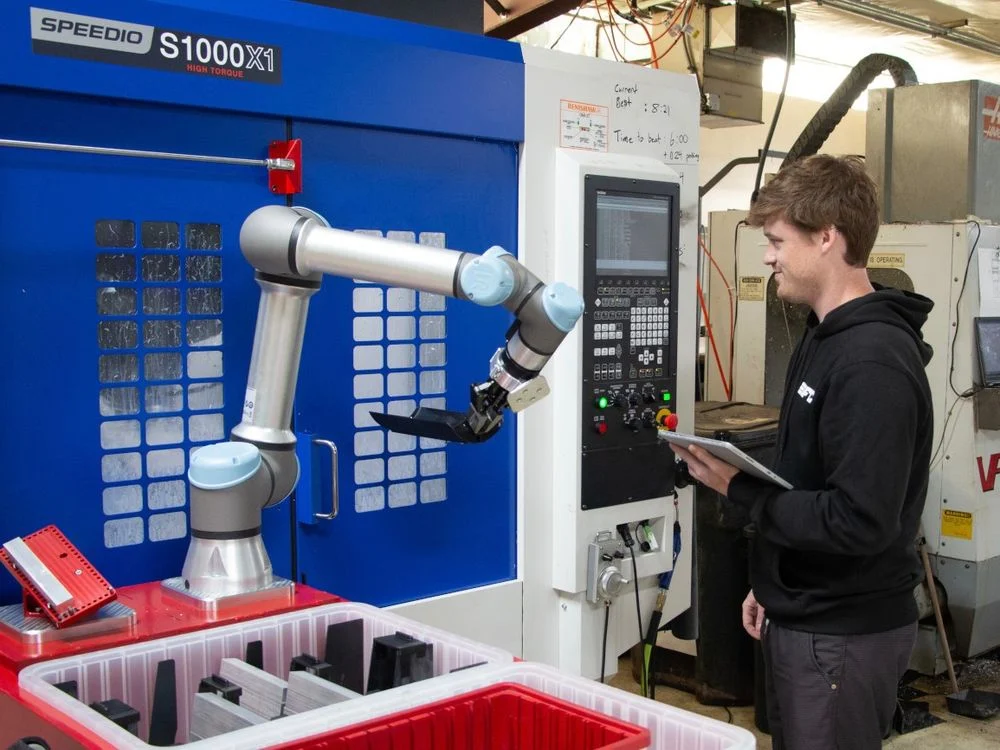
For machine loading, it is important not just to hold the part in the air. It must be placed in the fixture with the correct orientation and released after clamping. Therefore, tool access, space allowance, and behavior under slight misalignment are checked. A smooth movement above the table does not guarantee precise and reliable placement in the working area.
Describe separately how chips, coolant, and contaminated surfaces are handled. Not all tools are equally designed for such environments. It is useful to list operating conditions and cleaning methods in the technical specification, and confirm equipment suitability with documentation for the specific model. The decision on clamping and position control is made together with the process engineer.
Safety is assessed for the entire installation
The term 'collaborative robot' does not mean that any process can be run next to a person without additional measures. The cell contains a machine tool, moving tools, workpieces, and fixtures. Their combination determines the requirements for protection and operating modes. The project must include a risk assessment and agreed actions when an employee enters the hazardous area.
Before acceptance, typical situations should be reviewed: replenishing blanks, removing rejected parts, cleaning, and recovery after a stop. Operator training should cover these actions, not just the start button. Specific safety solutions are chosen by a competent designer, taking into account the equipment and installation site.
How to calculate the economic result
Compare the entire process before and after implementation. Consider not only manual loading time, but also downtime, yield, retooling, and maintenance. If the operator previously performed multiple tasks, you cannot automatically count all of their time as freed up. It is important to understand which actions actually disappear and what the employee will do instead.
For the initial model, it is useful to separate one-time and recurring costs. The former include equipment, tooling, integration, and site preparation. The latter cover maintenance, consumables, and labor for remaining operations. Payback calculations make sense only after these assumptions are tested in a pilot; a single 'cost per hand' does not describe the project cost.
What to include in acceptance testing
Before launch, agree on the test batch and success criteria. Measure full cycle time, installation stability, yield rate, and number of interventions. Separately record the time to switch to another part and the recovery procedure after a planned stop. This way, both the customer and integrator will have a common framework for evaluating the result.
- Parts from the approved sample go through the entire production cycle.
- Absence of a blank and unconfirmed gripping are handled in the prescribed manner.
- The machine and robot exchange signals correctly.
- The operator is able to replenish, retool, and service the installation.
- The documentation describes the application boundaries and support procedures.
Editorial conclusion by SHKARAN: it is best to start with a single measurable operation. Once the parts, conditions, and acceptance criteria are defined, choosing a manipulator becomes much easier. A good first cell is valuable not only for the additional working hours, but also for the clear experience that can then be applied to other areas.